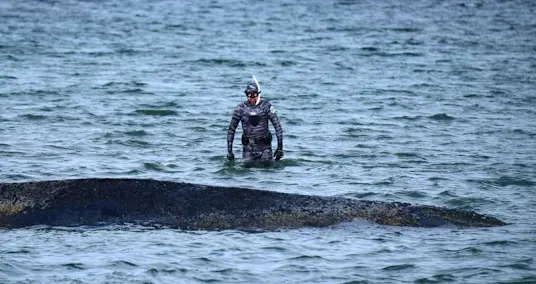
Rescuers on Thursday again attempted and failed to free a humpback whale stranded on Germany's Baltic Sea coast, employing a large suction dredger to remove sand around the animal.
Two excavators dug a trench in an attempt to free the whale, which has been stuck in shallow waters at the Timmendorfer Strand beach since early on Monday, drawing heavy media attention.
The aim of the latest rescue attempt was to approach the 12- to 15-metre-long marine mammal slowly, partly so that it can get used to the sounds, said Sven Partheil-Böhnke, the mayor of Timmendorfer Strand.
The work requires full concentration as rescuers are expected to reach within a centimetre of the animal's head, explained the mayor.
Excavator operator Tim Löhndorf told dpa on Wednesday that the plan was to dig a trench 50 metres long, six metres wide and 1.20 metres deep in front of the whale's head.
Wind and currents would pose particular challenges during the rescue operation, he said.
Before the rescue attempt began, biologist Robert Marc Lehmann approached the stranded animal, which reacted with movement and loud snorting.
The diver's assessment showed that the animal appeared to be in relatively good condition, said Stephanie Gross from the Institute for Terrestrial and Aquatic Wildlife Research (ITAW), adding that the whale seemed motivated.
Efforts to free the huge seaborne mammal continued into the night but were ultimately called off late on Thursday and are set to resume on Friday. By Thursday evening, however, the animal had at least managed to shift its position slightly, a dpa reporter said.
Even if the whale can be successfully freed, it will not yet be out of the woods. As the Baltic Sea is not its natural habitat, it must find its way back to the North Sea and then on to the Atlantic without becoming stranded again.
The Baltic Sea presents a bottleneck, said Jan Herrmann, a vet and whale expert from Wilhelmshaven.
"It has to find the way out again, and it is not entirely certain that the humpback whales' navigation system is designed for that," Herrmann said.
ITAW expert Joseph Schnitzler said the whale would certainly need to be escorted to find its way out.
"And then we'll just have to hope that the animal makes the right decisions, because you can't really guide it," he added.
The humpback whale was discovered on the sandbank on Monday morning. On Tuesday, a rescue attempt with a small suction dredger failed.
Attempts to make waves using police boats to allow the whale to swim free also proved unsuccessful. Even the high tide on Tuesday night was not enough to free the trapped sea mammal.
According to experts, humpback whales can weigh up to around 30 tons and have a life expectancy of up to 90 years. The species is characterized by its long pectoral fins, which reach a third of its body length.

LATEST POSTS
- 1
 Polar bears are rewiring their own genetics to survive a warming climate
 - 2How on earth did 'Shark Tank' star Kevin O'Leary end up in 'Marty Supreme'? I'll let him explain.
- 3Our 10 favorite Space.com reader astronomy photos of 2025
- 4The Main 20 Gaming Control center Ever
- 5Anger as German family business group opens talks with far-right AfD


- Partner of crime boss Steven Lyons arrested in Dubai
- A definitive Manual for the 5 Off-road Bicycles Available
- Collins Foods to offload 20 Taco Bell outlets in Australia
- Five EU states press for windfall taxes on fossil energy sector
- Between 600 to 800 aid trucks entering Gaza daily since start of ceasefire, COGAT confirms
- Kremlin: Russian troops conquer Pokrovsk after year of intense combat
- Instructions to Grasp the Innovation Behind 5G Pinnacles\
- 6 Solid Moving Administrations for a Calm Movement
- Some are walking out. Some are shouting. Some are oblivious. How kids are reacting to THAT 'Wicked: For Good' scene